
We will help you with the (non-)registration of polymers under REACH

The issue of classifying a substance as a polymer under the REACH Regulation is far from straightforward and often gives rise to a number of uncertainties in practice. Although the definition of a polymer may appear clear at first glance, its application to specific substances can be complex. A key challenge lies in the interpretation of criteria such as molecular weight distribution, the proportion of individual constituents, and the requirement for repeating structural units.
Another difficulty is that manufacturing processes can result in mixtures of substances that lie on the borderline between a polymer and a non-polymeric substance. In such cases, detailed analytical assessment and often expert judgment are required, increasing both uncertainty and administrative burden. In addition, differing interpretations by manufacturers, importers, and regulatory authorities may lead to inconsistent practices.
An important factor is also that polymer status has a direct impact on registration obligations under REACH. Incorrect assessment may therefore have both legal and economic consequences. It is therefore essential to pay increased attention to this issue and, in case of uncertainty, to consult experts or relevant guidance documents.
Our solution:
We have suitable analytical methods for the accurate determination of molecular weight and polymer composition (Gel permeation chromatography). We assist clients in correctly classifying their substances under REACH, thereby reducing the risk of misclassification and simplifying the registration process.
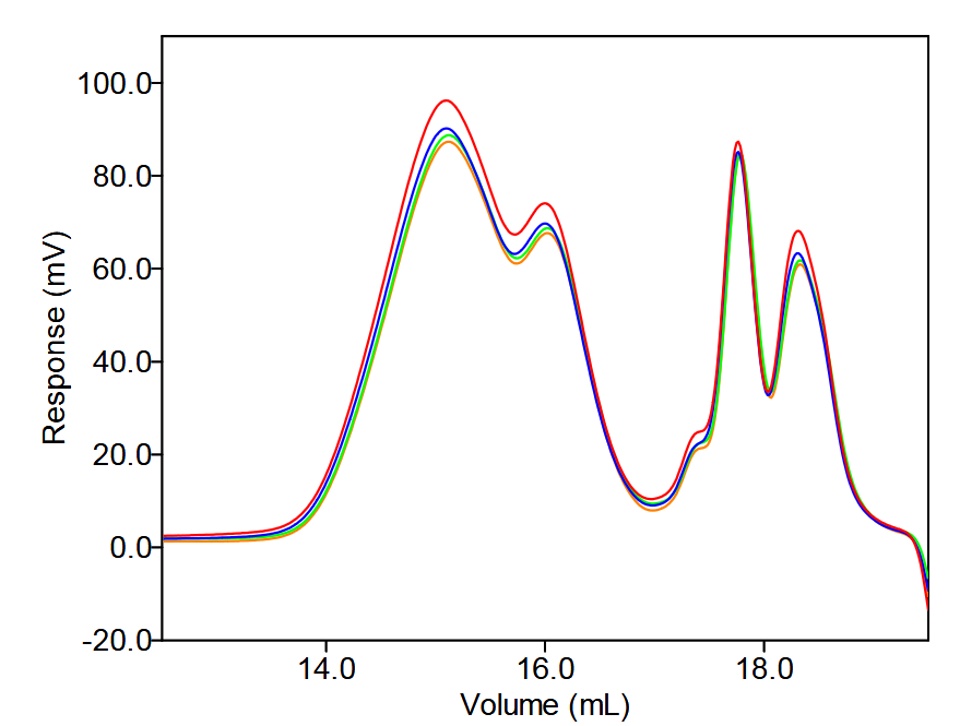
Chromatogram of a mixture of oligomers and monomers – a common starting point for polymer formation